
Modern & Contemporary Stained Glass | When glass becomes a contemporary art form in modern homes.

Updated: Feb 23
Modern and contemporary stained glass marks a period where it has truly been liberated from all its traditional constraints. It no longer needs to tell religious stories, nor the floral patterns of Art Nouveau, and it is no longer bound by classical opulence. Stained glass in this era has become “pure art” that speaks solely through form, color, light, and emotion.

Historically, stained glass has been a medium of faith, a storytelling tool, and a symbol of luxury. However, in the Modern era, it's being viewed differently – as an art material with inherent power, requiring no narrative or symbolism. The simple arrangement of glass panels, color, and light can convey emotion.
The heart of Modern stained glass lies in "simplicity" and "clarity." Patterns often feature geometric shapes, straight and diagonal lines, squares, circles, or spatial divisions using calm, rhythmic colored panels. The design approach is more like abstract art than mere decoration.
Color can be extreme; one approach uses monochrome tones such as white, gray, black, brown, cream, or earth tones to complement minimalist architecture. The other approach utilizes vibrant, bold colors reminiscent of abstract art, such as red, yellow, blue, and green, arranged in sharp blocks to create powerful emotional impact.

Image source: Replica House Studio | Surman Weston Ltd | Archello
In this era, the lead lines are becoming less prominent. From the thick and striking lines of the past, they are now thin, smooth, or even almost invisible in some works. Thin metal or steel frames are used instead to create a cleaner overall look, allowing the glass to truly function as a medium of color and light.
Modern stained glass, therefore, doesn't need to be "sweet" or "delicate," but rather conveys a cool, calm, strong, and subtly powerful aura. Entering the Contemporary era, the concept became even more open. Stained glass is no longer limited to window or door panels; it can encompass entire wall art, light sculptures, room dividers, installation art, or even gallery displays.

Image source: Credenza: Patricia Urquiola for Spazio Pontaccio
Glass doesn't just serve the purpose of "letting light through," but becomes a material artists use to create experiences for viewers. The changing light throughout the day transforms the mood of the artwork, making each piece truly unique.
Another highlight of contemporary stained glass is the combination of materials. Glass isn't alone; it's often combined with wood, steel, concrete, stone, brass, acrylic, or even recycled materials. Mixing these materials creates a raw, cool, deep, and multi-dimensional look—not a sweet or luxurious aesthetic, but a beauty of contemporary art.
In modern homes, stained glass is often used as a "focal point" rather than scattered throughout the house. A single large stained glass panel in the hallway, a stained glass partition between spaces, a skylight above a doorway, or an wall art piece behind a sofa—just one spot can transform the personality of an entire home.

Image source: <>HOME // HANNES PEER ARCHITECTURE
Minimalist homes often use light-colored or monochrome stained glass to add texture to the space without compromising its simplicity.
Modern luxury homes prefer stained glass with a metallic sheen or deep, dark colors to add a contemporary touch of luxury.
Loft-style homes frequently use stained glass in combination with black steel frames, creating a raw, cool, and industrial aesthetic.
The charm of stained glass in this era lies in its "flexibility." It doesn't dictate what kind of beauty it should have or what colors to use. Everything depends on the emotion you want to convey. Some pieces appear calm and serene; others are strong, bold, and defiant. Some are warm and gentle; others are cool, raw, and powerful. All of this comes from simply the glass, light, and arrangement.
In architecture, stained glass in modern and contemporary styles is often designed as part of the building's structure, rather than added later like typical decorative elements. Architects consider from the outset where and when light will enter, and how it will reflect off the glass onto the floor or walls. This makes the glass an integral part of the spatial structure and experience. Therefore, stained glass is not merely "ornaments," but truly "an integral part of the architecture."
Another thing that makes the Contemporary era interesting is the embrace of new technologies such as safety glass,
special coated glass, sun-resistant and heat-resistant glass, combined with modern structures, allowing stained glass to be used outdoors or in areas that were previously unsuitable for traditional stained glass.
From an emotional perspective, stained glass in this era reflects the identity of the homeowner or designer the most. It doesn't speak of shared beliefs or universal nature, but rather of "taste" and "identity." Those who prefer tranquility choose still designs; those who like boldness opt for vibrant pieces; those who prefer simplicity choose monochrome; and those who appreciate art choose abstract designs. All of this can be achieved through stained glass.
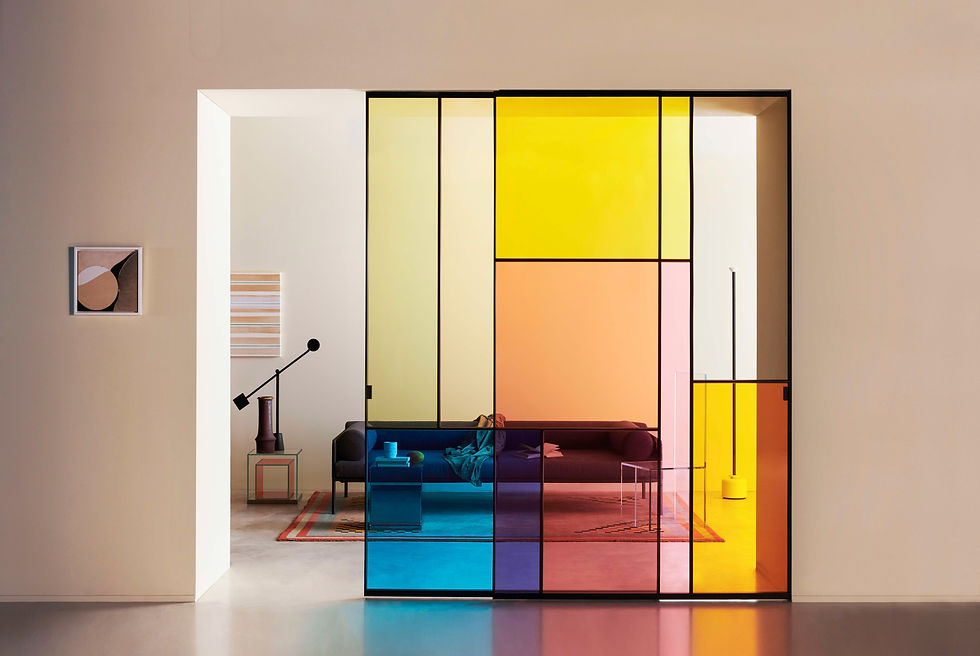
Image source: glasitalia.com/en
In short, Modern & Contemporary stained glass is an era where it truly becomes a full-fledged art form. From a material that once served religious and architectural purposes, it has evolved into a free artistic language without boundaries, formulas, or right or wrong.
It's an era where glass is not just "beautiful,"
but "communicates,"
not just "provides light,"
but "creates emotion,"
and not just "decorates,"
but "creates identity for a space."
This is why Modern & Contemporary stained glass has become a key choice for modern homes, cafes, galleries, hotels, and art spaces worldwide. It's not just a craft; it's a living art form, changing with light and time every day.


Comments